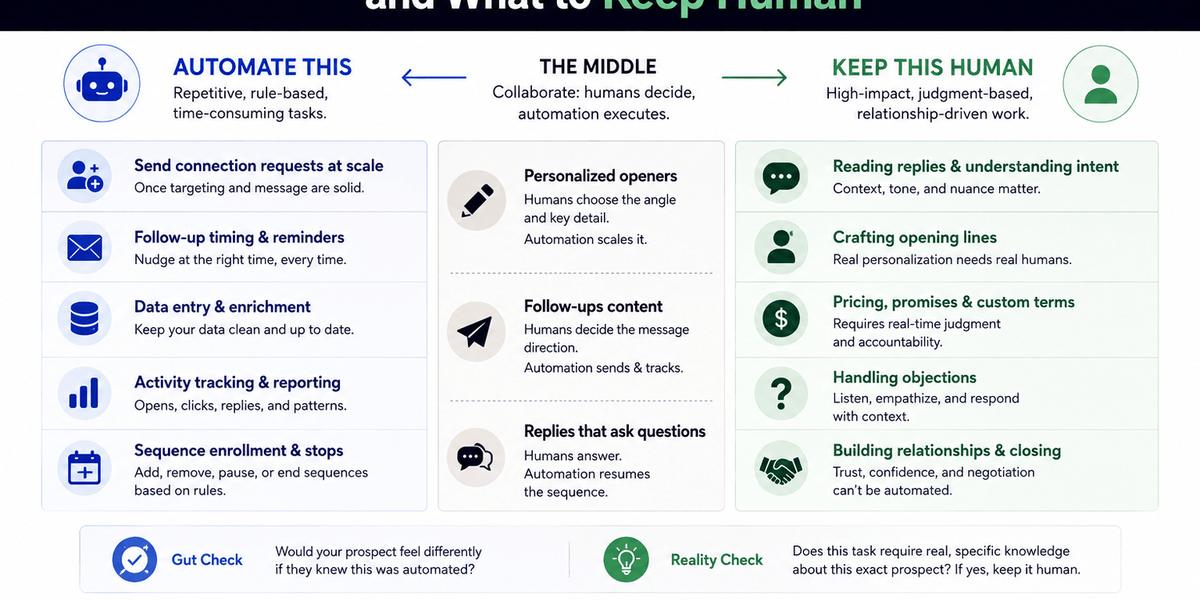
What Shouldn't Go Anywhere Near Automation
A few things fall apart the second you hand them to a machine, no matter how good the tool is.
Reading a reply and figuring out what someone actually meant, for one. "Not right now" could mean bad timing, wrong person, mild interest, or a polite no—and getting that wrong either kills a decent lead or annoys someone who already told you to back off. That's a judgment call every time.
The actual opening line of a cold message matters too. Templates are a fine starting point, but if the first sentence reads identical to fifty other prospects, people notice—that's where an actual read of someone's profile or their last post needs to show up, not a variable slotted into a sentence.
And anything involving a promise or a number specific to that one prospect—pricing exceptions, custom terms, "yes, we can hit that deadline"—needs a person who actually knows what's true right now, not a rule written into a system three months ago.
What's Fine to Hand Off Without Feeling Bad About It
On the other end, some tasks genuinely don't need a human doing them by hand, and holding onto them out of habit just slows the whole process down.
Sending connection requests at scale is the obvious one; once the message and the targeting are actually solid, there's no version of clicking "connect" 80 times a day that makes someone better at their job.
Follow-up timing is another. If a prospect doesn't reply in three days, a system remembering to nudge them again is exactly the kind of thing computers are better at than people. People forget. Tools don't.
Data entry too—nobody's career improved from manually copying a job title off LinkedIn into a spreadsheet.
Same with tracking who opened what and who's gone quiet. That's pattern recognition across a few hundred contacts at once, and honestly no one remembers 200 individual conversations accurately, no matter how organized they think they are.
The Middle Is Where Most Teams Get It Wrong
The real damage usually doesn't happen at either extreme—it happens in the gray area, where teams either automate too much or refuse to automate anything out of a kind of stubborn pride in doing it "properly."
Personalized openers are the clearest example. Automate them fully—pull a random fact, drop it into a template—and you get messages that are technically personalized but still feel hollow. "Saw you work at [Company], impressive!" isn't personalization; it's mail merge wearing a disguise. But writing every single opener from scratch stops scaling pretty fast too. What actually works: a person decides the angle and picks the one detail worth mentioning, and the tool just handles getting that into the message at volume. The thinking stays human. The typing doesn't have to.
Follow-ups work the same way. Deciding when to follow up, and roughly what to say, can be automated reasonably well. But the moment a prospect asks something specific in a reply, that answer needs to come from someone who read the actual question—not a canned response that half-answers something adjacent to it.
A Quick Gut Check
If you're not sure which side something lands on, ask whether the prospect would think differently about the company if they found out it was automated. Sequenced follow-up emails? Nobody cares. A "personalized" message that's obviously templated? People notice, and it costs you more than the time it saved.
There's a second test too: does this task depend on knowing something real and specific about this exact prospect that a database field doesn't already cover? If yes, keep a person on it. If the honest answer is "not really, a data field basically handles this," it's safe to automate.
Where This Actually Pays Off
Get the split right, and outbound stops feeling like a tradeoff between volume and quality. Reps spend their time on the handful of moments that genuinely need a person—the sharp opening line, the real answer to a real question, and the call on whether someone's actually interested. Everything else runs quietly in the background without anyone needing to babysit it.
Swapped the closing links to two posts that actually fit better here—The Right Way to Personalize Outreach at Scale in 2026 (same automation-vs-human line, different angle) and How to Turn LinkedIn Prospects Into Email Conversations (the handoff point where automating too early tends to backfire). Both are real live posts on the blog, so the links are solid.