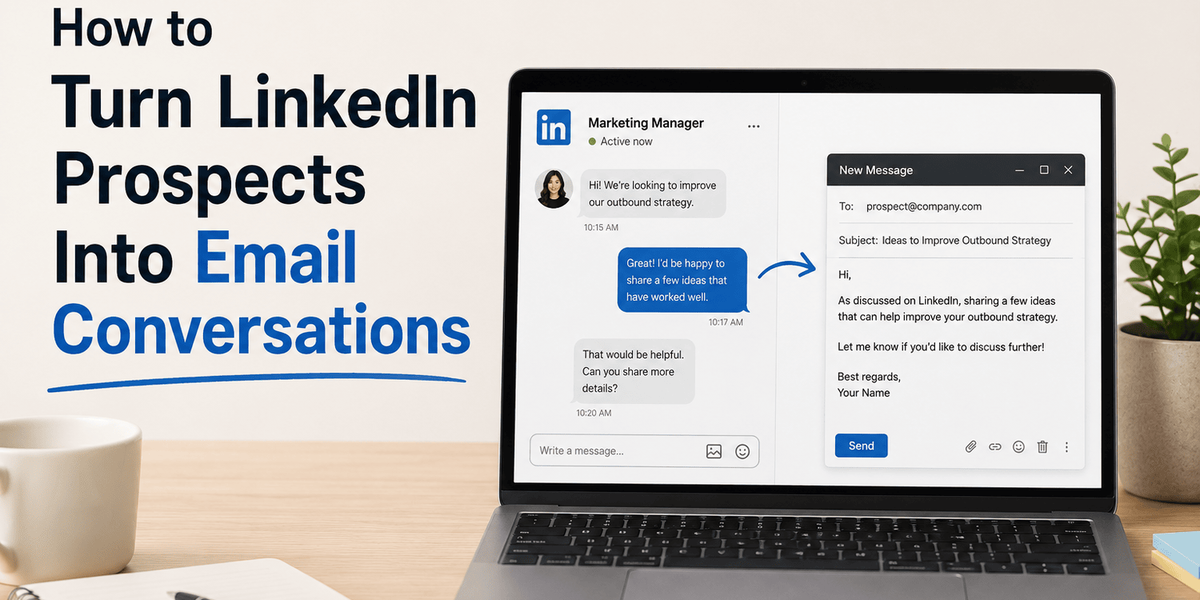
Why Even Bother Switching Channels?
If LinkedIn's working, why leave it? A few honest reasons.
LinkedIn messages get buried fast. Even a prospect who's genuinely engaged checks their inbox way more than their LinkedIn messaging tab, especially once the "nice to connect" phase is over.
Email also just carries more weight inside a company. If your prospect wants a manager or teammate looped in, forwarding an email is completely normal. Forwarding a LinkedIn DM thread rarely happens—it's clunky, and nobody does it.
And it's more durable. LinkedIn threads get buried under notifications, and if the prospect changes jobs or the connection breaks somehow, that conversation is just gone. An email address sticks around.
None of this means drop LinkedIn. It means recognizing when its job is basically done and emails are about to start.
When It's Actually Time to Move
Timing matters more than wording here. A few signs it's the right moment: they've replied more than once, and there's some real substance to it, not just "sounds good, thanks." They've asked for something that needs more than a quick DM back—pricing, a case study, or an actual explanation. They've brought up wanting to loop someone else in. Or the conversation is drifting toward scheduling, and honestly a calendar link beats typing back and forth for another three messages.
If none of that's happened yet, pushing for email too soon usually backfires—it comes across as impatient and can undo whatever rapport you'd built up to that point.
Actually Asking for the Email
This is where people get clumsy. "Can I get your email?" out of nowhere feels transactional, even if everything before it was warm. A few things that tend to work better.
Give them a reason first. Something like "I've got a quick breakdown of how [similar company] handled this—easier to send over email, want it?" You're not asking for the email for its own sake; you're offering something that happens to need it.
Sometimes it's smoother to just let them ask. Answer well on LinkedIn, and a decent chunk of the time they'll say, "Can you send that over?" on their own—people do this more than you'd expect when the answer's actually useful.
Lead with scheduling instead of the email itself. "Want me to send over a couple of time slots?" gets you to the same place without it feeling like you're collecting contact info.
And if the relationship's already warm, there's nothing wrong with just being direct—"Mind if I email you the details? Easier to keep track of than LinkedIn." Most people don't mind the honesty.
A Few Things Not to Do
Don't ask for an email in your very first message—it skips the part where they actually trust you enough to hand it over.
Don't disappear from LinkedIn the second you receive the address. If they respond to your email and then never hear from you on LinkedIn again, it can feel like you got what you wanted and left.
Don't send a generic "just following up" email that has nothing to do with what you actually discussed on LinkedIn. If the conversation doesn't continue, the transition feels like starting from scratch, which defeats the purpose.
Keeping It Simple
Build a real back-and-forth on LinkedIn first, not just one message and a quick reply. Watch for a natural reason to move—a question, a request, a scheduling moment.
Offer something that makes email the clear next step instead of just asking for it directly. Mention the LinkedIn conversation in your email so it doesn't seem like a new beginning. And keep both channels a little warm until the deal, or the no, is actually decided.
This is also where things tend to fall apart in practice—remembering who said what, who's ready for email, and who's still warming up. That gets tedious once you're juggling more than a handful of conversations, which is really the problem outreach tools are meant to take off your plate, not replace the judgment calls above.
If your opening message needs work, that's worth fixing first—we went into what actually gets people to respond in 10 LinkedIn Connection Request Messages That Actually Get Accepted. And once channel-switching starts eating up your whole day, The Right Way to Automate LinkedIn Outreach in 2026 is worth a read.