Why So Many Requests Get Ignored
Three habits do the most damage:
Opening with something generic. "I came across your profile" could apply to literally anyone, and prospects can tell.
Selling before you've even connected. If your invite reads like a pitch, most people won't stick around to hear the rest.
Skipping context. People say yes to requests that feel like they belong—same industry, same event, a mutual contact, a shared problem. Strip that out, and you're just another stranger in their inbox.
Keep those in mind, and the templates below will make a lot more sense.
10 Openers Worth Trying
- The mutual connection nod: "Hi [Name], noticed we're both connected with [Mutual Contact]—small world. Would love to add you to my network too."
This borrows trust. If someone they already know vouches for you (even indirectly), you've skipped a few steps.
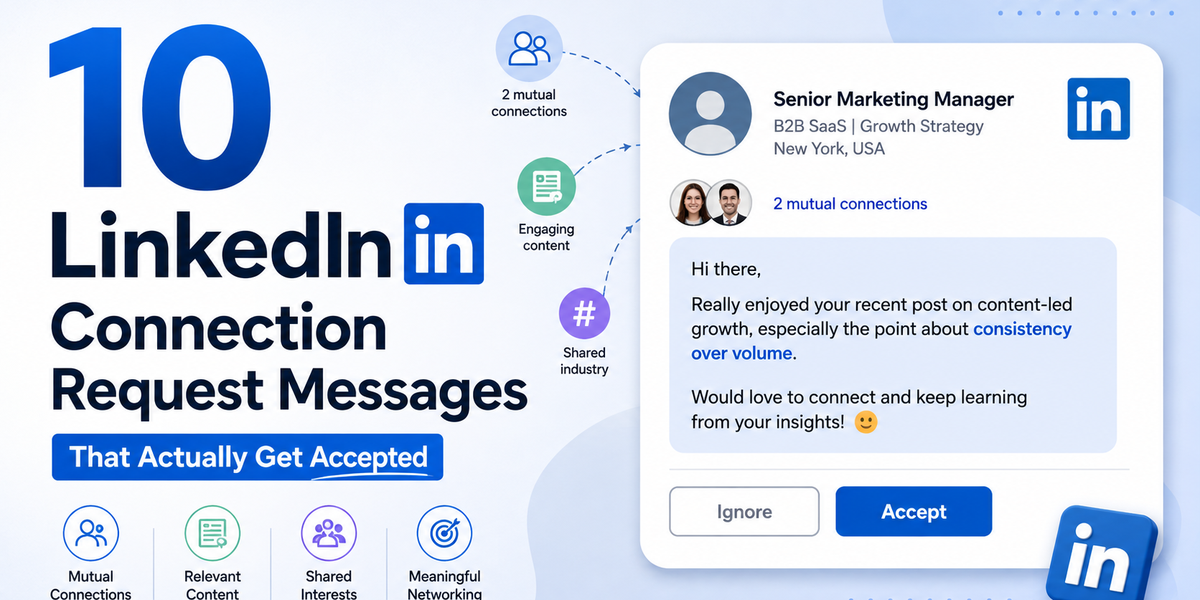
- The content callback: "Hi [Name], your post on [specific topic] really landed for me, especially the bit about [detail]. Would love to connect and keep an eye on what you're posting."
Specificity is what sells this one. Name the actual post, not "your content"—that's the difference between reading someone's work and pretending to.
- The shared group: "Hi [Name], saw we're both in [Group name]. Always worth connecting with others in the same space."
Low-key, it doesn't feel like a pitch, and it's true—you are both in the group.
- The event follow-up: "Hi [Name], great meeting you at [event]—really liked your take on it." Let's stay in touch."
Only works if it's true, obviously. But when it is, this converts better than almost anything else on this list, because there's already a real interaction to point back to.
- The genuine curiosity opener: "Hi [Name], I've been watching [Company]'s growth in [industry/region] and would love to connect and hear more about what you're building."
This one only works if you mean it. If you clearly haven't looked at the company, it falls flat fast.
- The peer opener: "Hi [Name], I work alongside a lot of [similar role] in [industry] and like keeping my network full of people doing similar work. Would love to connect."
Frames you as a peer instead of a vendor, which softens the guard most prospects put up automatically.
- Lead with something useful: "Hi [Name], put together a short breakdown on [relevant trend or challenge]—a few [job titles] have found it useful. Thought it might be relevant to you too; happy to connect either way."
"Happy to connect either way" removes the pressure, which oddly makes people more likely to say yes.
- Just be upfront about it: "Hi [Name], I'll be honest—I help [role] like you with [specific problem]. No pitch in this message, just want to connect and swap ideas."
Some prospects respond better to directness than to a disguised pitch. Naming what you do, without asking for anything yet, reads as confident rather than pushy.
- Shared background: "Hi [Name], fellow [university/former company] alum here—always nice reconnecting with people from [shared background]."
Shared history, even a loose one, is one of the strongest trust signals LinkedIn has.
- The plain, no-frills request: "Hi [Name], I'd like to add you to my professional network."
Sounds too simple to work, but it often does — especially with prospects who already know who you are because they've seen your posts, visited your profile, or interacted with your company page. Sometimes the default message is fine.
Before You Hit Send
- Does it mention something specific about them, not your product?
- Is it under 300 characters?
- Would it sound normal if you said it out loud to a stranger?
- Have you actually checked that they're a fit for your ICP?
- Did you avoid "pick your brain" or "quick question" — both are worn out at this point?
- Does it stay away from naming your product or service?
If most of those check out, send it. If your profile itself isn't doing its job, that matters just as much as the message—we covered what to fix in the LinkedIn Profile Checklist for Successful Outbound Prospecting, since a lot of prospects click through to your profile before deciding.
After They Say Yes
Getting the connection accepted is the easy part, honestly. What happens next is where most outbound falls apart — no follow-up plan, no tracking, no idea who to circle back to and when. We went deeper on how stronger teams handle that stage in How Smart B2B Teams Use LinkedIn to Generate Opportunities. And if you're planning to send any of this at real volume, it's worth reading The Right Way to Automate LinkedIn Outreach in 2026 first — scaling up is where most people start sounding like a bot again.