Start with the problem, not the job title
Instead of asking "who should I contact," try asking "who actually deals with this problem every day?"
If your tool saves marketing teams time, you're probably not chasing the CEO. You want someone closer to the daily work, a marketing manager or a team lead who feels that pain firsthand.
People buy solutions for problems they live with, so start there and work outward.
Find the decision-maker, not just the user
There's usually a gap between the person who'd use your product and the person who can say yes to buying it.
Sometimes they're the same. Often they're not. Ask yourself who benefits most from what you're offering, and separately, who controls the budget.
In a small company that might be one person. In a bigger one, you may need to win the user over first and let them walk you to whoever signs off.
Let company size guide you
Company size tells you a lot. At a small company, the founder usually still makes most calls, so go straight to them.
At a mid-sized company, look for department heads and managers, since they tend to have both the authority and the everyday awareness of the problem.
At a large company, you'll usually need to go a level or two below senior leadership, closer to where the real, hands-on decisions happen.
Use LinkedIn properly
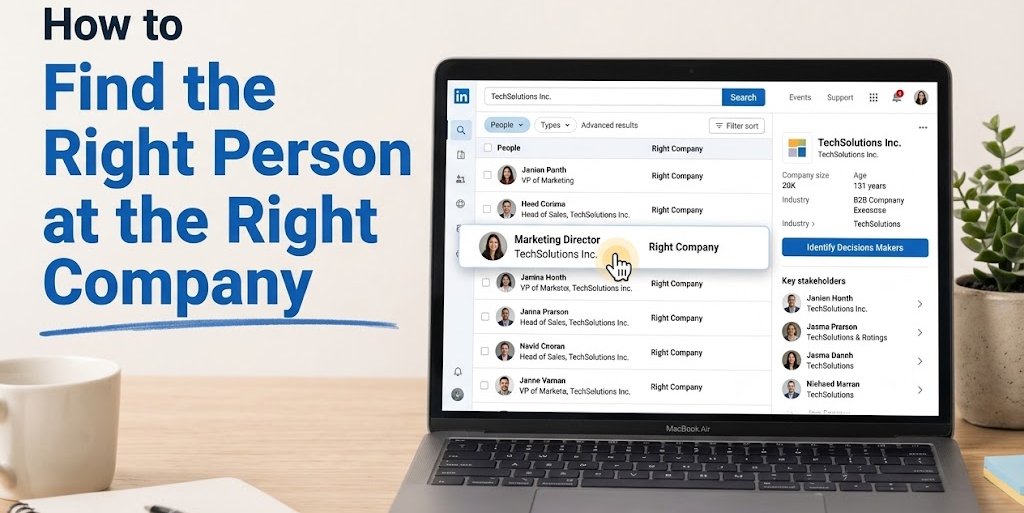
LinkedIn is still one of the best free tools you have for this. Search the company, then filter by title or department, and don't stop at the first result.
Look through a few profiles and see who actually talks about the kind of problems you solve. Sometimes a title will say "Manager" while the profile makes it clear they're the one really driving that decision.
For a more repeatable process, here's how smart B2B teams use LinkedIn to generate opportunities instead of guessing every time.
Once you've found the right person, don't stop at LinkedIn either. Pairing LinkedIn with email gives you two chances at a reply instead of one, and it's a far more reliable way to actually reach someone than relying on a single channel.
Talk to the gatekeepers
Assistants, coordinators, junior team members, they usually know exactly who handles what. If you're stuck, just ask.
A short, polite message like "who usually handles [specific task]?" tends to get you further than you'd expect.
Most people are happy to point you in the right direction if you're clear and respectful about it.
Check before you commit
Even after doing your research, it's worth confirming. Something as simple as "Are you the right person to speak with about [specific need], or could you point me to who is?" respects their time and saves your best pitch from landing in the wrong inbox.
At the end of the day, finding the right person isn't about guessing well. It's about matching the problem you solve to whoever actually feels it and can act on it.
Spend the extra few minutes figuring that out before you hit send. It's usually the difference between a message that gets read and one that gets deleted.
Related reading