Why personalization falls apart once volume goes up
When volume increases, the instinct is to simplify. Fewer variables, faster sends, less thinking per message. That instinct is fine for almost everything else in sales. This's the wrong move for personalization, as simplifying it can undermine it.
Here's the pattern I keep seeing. A rep starts out writing genuinely thoughtful first messages, and reply rates hold up fine. Then leadership asks for more activity, and the rep slowly starts reusing the same opener across dozens of prospects, swapping only the name and company. Reply rates drop, but nobody catches it for a few weeks because the number of messages sent still looks healthy on the dashboard.
Prospects notice the shift immediately, even when they couldn't tell you exactly why. A message that references something specific about them reads as "this person actually looked at my profile." A message with a name token and a generic pitch reads as "this went out to a list." And people, generally, don't reply to lists.
What personalization is actually made of
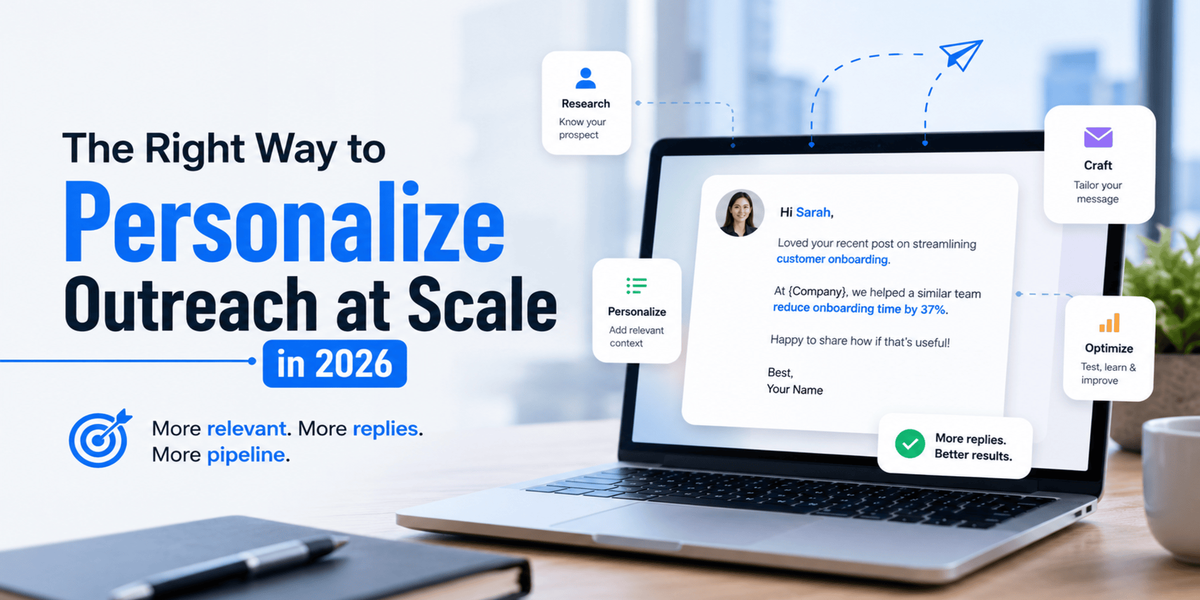
It helps to drop the idea that personalization means inserting a variable. There are really three layers to it, and most outreach never gets past the shallowest one.
Surface-level tokens — name, company, job title — are table stakes at this point, not personalization. If that's where the effort stops, prospects notice, because everyone does this now and it stopped registering as effort a long time ago.
Then there's contextual personalization: referencing something specific and verifiable, like a post someone wrote, a recent job change, a company announcement, or content they engaged with. This is usually where reply rates actually start moving, because it proves a person did something a script couldn't fake as easily.
The third layer is behavioral or trigger-based personalization — reaching out because something just happened. They viewed your profile. They posted about a problem your product solves. Their company opened a role that signals budget. Here, the message isn't just personalized in what it says, it's personalized in when it arrives, and timing matters more than most reps give it credit for.
Most teams stop at layer one and call it personalization. The teams actually getting strong reply rates are working in layer two and three, and they're not doing it by typing more carefully — they've built a process around it.
Turning this into a repeatable system, not a habit
This is the part most people skip. They know contextual and trigger-based personalization works better, try to do it by hand for every single prospect, and it collapses the moment they need to send more than a handful a day.
A few things make it repeatable instead.
Start by segmenting before you personalize. You don't need a unique message for every person; you need a unique message per segment, with room for one or two specific details layered on top. Group prospects by role, industry, or whatever trigger got them on the list in the first place — funding, hiring, engaging with content — and write the base message once per segment rather than starting over for every name.
It also helps to build a bank of context, rather than researching each prospect fresh every time you sit down to write. Pull recent posts, job changes, or company news for the whole list at once, on a schedule, so the research is already sitting there when you go to write. The writing itself then takes seconds instead of eating your whole morning.
And separate the parts of a message that change from the parts that don't. Every message has a skeleton — the ask, the value prop, the tone — and a few variable slots where the specific hook goes. Write the skeleton once per segment, fill the slots per person. That's really the mechanism behind personalizing at scale. Not writing more, just building templates with fewer, better-placed variables.
This is also roughly where a tool like DoReach earns its keep. Doing the manual version of this — pulling signals, segmenting lists, tracking who got which version of a message — is fine at twenty prospects a week and unmanageable at two hundred. Automating the list-building and sequencing side of it frees up the time for the part that can't be automated, which is picking the right hook for each segment. The tool isn't writing the personalization for you. It's giving you back the hours you'd otherwise lose to the mechanical side, so you can spend them on the part that actually needs a person thinking.
Where this quietly turns fake again
Even with a decent system behind it, personalization at scale tends to slip back into looking fake in a few predictable ways.
There's fake specificity — "I saw you're the VP of Sales at [Company]" isn't specific; it's a job title pulled from a CRM field. Real specificity references something that took actual looking, like a comment someone left or a point they made on a podcast.
There's personalizing the opener and nothing else. A lot of sequences put all the effort into the first line and then drop straight into generic pitch mode for everything after. Prospects read the whole message, not just line one, so if the personalization doesn't carry through, the shift into generic territory just becomes more obvious by contrast.
There's over-explaining the research. "I noticed you posted about X, which is interesting because Y, and that's why I wanted to reach out about Z" loses the reader by the third clause. Reference the detail, then get to the point — the personalization is there to earn attention, not to spend all of it.
And there's treating personalization as something that only happens once. If the first message references something specific and the follow-up two days later reads generic, you've basically told the prospect the personalization was a trick to get the first reply, not how you actually operate. It needs to carry through the whole thread, not just the opening line.
Quick-reference checklist
- Go past name-and-company tokens — reference something specific and verifiable
- Segment the list before personalizing, rather than starting from scratch per person
- Pull context signals in batches on a schedule, not one prospect at a time
- Keep a fixed message skeleton per segment, with a few variable slots for the specific hook
- Let the personalization carry through the whole message, not just the opener
- Keep follow-ups consistent with the personalized first touch
- Automate the mechanical parts — list building, sequencing — so the time saved goes toward judgment calls, not busywork