What Is Email Warmup and Why Cold Outreach Fails Without It
Email MarketingBy Avis Sharma · Sep 27, 2026
Email warmup builds sender reputation before you send cold outreach at scale. Learn how it works, how long it takes, and what happens if you skip it.
What Is Email Warmup and Why Cold Outreach Fails Without It
Most teams that give up on cold email don't have a messaging problem.
They have a warmup problem.
The campaign gets built, the list gets loaded, and on day one a brand-new sending domain fires off 200 emails — straight into spam folders it hasn't earned the right to skip.
No amount of clever copy fixes what happens next.
Email warmup is the process that prevents this.
It's not a growth hack or an optional extra — it's the mechanism that tells inbox providers your domain is trustworthy before you ask them to deliver anything at volume.
Skip it, and even a well-targeted, well-written sequence can die in spam before a single prospect sees it.
What Email Warmup Actually Is
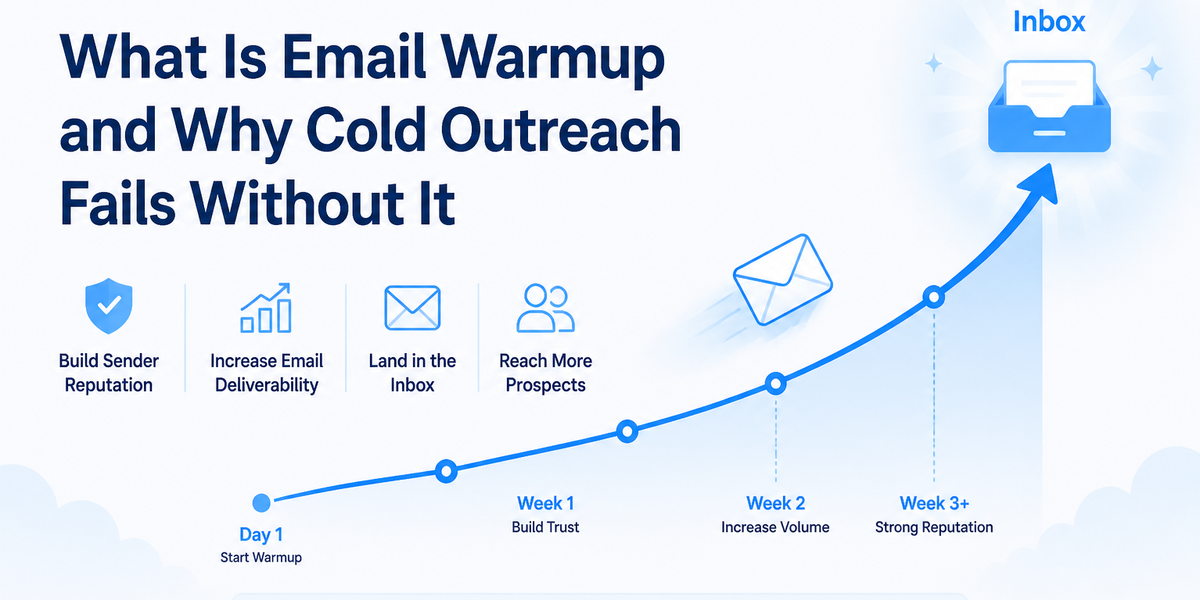
Email warmup is the gradual process of building sending reputation for a new or underused email address by having it send and receive email in patterns that look genuinely human — low volume at first, increasing steadily, with real opens, replies, and occasional "move out of spam" signals along the way.
Inbox providers like Google and Microsoft don't evaluate a single email in isolation.
They evaluate the sender — the domain, the IP, the account history — and decide in real time whether that sender's mail belongs in the inbox or the spam folder.
A domain with no sending history, or one that suddenly spikes in volume, looks exactly like the pattern spammers use.
Warmup exists to give a new sender a track record before it needs one.
Why Cold Outreach Fails Without It
Skipping warmup doesn't just risk a few messages landing in spam — it can damage sender reputation in ways that outlast the campaign that caused it.
- New domains have zero reputation.
A domain registered last week, sending 300 cold emails on day one, has no history for providers to trust.
That volume-with-no-history pattern is one of the strongest spam signals there is. - Reputation is shared across everything you send.
Once a domain gets flagged, every subsequent campaign — even a well-targeted one to warm leads — inherits that damaged reputation.
Recovery can take weeks. - Bounce and spam-complaint rates compound.
A cold list sent without warmup tends to produce more bounces and spam reports, which further degrades reputation, which increases the odds the next send also fails. - Blocklisting is often invisible until it's too late.
Teams frequently don't discover a domain has been blocklisted until reply rates have already collapsed for weeks — the sender never gets a warning, just silence where replies used to be.
The pattern shows up constantly in deliverability post-mortems: a team checks which addresses are actually sending their mail, only to discover a handful of unwarmed or previously-flagged addresses are quietly doing most of the damage while the rest of the domain looks fine.
How Email Warmup Works, Step by Step
- Start with minimal volume.
A new mailbox typically begins sending just a handful of emails a day — often to a network of other warmup accounts designed to open, reply, and mark messages as "not spam." - Simulate real engagement.
Warmup tools generate opens, replies, and positive engagement signals that mimic how a real recipient interacts with wanted email — the opposite of the ignored-and-deleted pattern spam collects. - Ramp volume gradually.
Over roughly 2-4 weeks, sending volume increases in small increments rather than jumping straight to campaign-level output. - Monitor placement, not just delivery.
Good warmup tracks whether mail is landing in the primary inbox versus spam or promotions — delivery without inbox placement isn't a win. - Maintain warmup indefinitely, not just at setup.
Reputation isn't a one-time achievement.
Mailboxes that go quiet for stretches, or that suddenly increase volume again, can see reputation slide even after a successful initial warmup.
How Long Warmup Takes
Most warmup services recommend 2 to 4 weeks before a new domain or mailbox is ready for full outreach volume, though the right timeline depends on a few factors:
| Factor | Faster warmup | Slower warmup |
|---|---|---|
| Domain age | Established domain, new mailbox | Brand-new domain |
| Starting volume | Conservative ramp | Aggressive early volume |
| Engagement quality | Genuine opens/replies | Bot-only engagement signals |
| Sending consistency | Daily, steady | Sporadic, bursty |
Trying to compress this timeline is one of the most common ways teams sabotage their own deliverability before a campaign even starts.
Common Email Warmup Mistakes
- Skipping warmup on "just one more" mailbox.
Every sending address needs its own reputation — adding an unwarmed mailbox to an otherwise healthy domain still introduces risk. - Warming up, then going silent.
A mailbox that warms up successfully and then sits unused for a month effectively resets some of that trust. - Treating warmup as a substitute for list quality.
Warmup builds sender reputation; it does nothing to fix a stale or inaccurate list, which independently drives bounces and complaints. - Assuming "delivered" means "inbox."
A message can technically deliver while still landing in spam or promotions — that distinction is what actually determines whether a prospect ever sees it. - Not checking which addresses are really sending.
It's common for a domain's SPF record to authorize far more sending addresses than are actually active — and for reputation problems to trace back to just one or two of them.
Warmup Is One Piece of a Bigger System
A healthy sending domain is necessary but not sufficient — it's the foundation a good sequence gets built on top of, not a replacement for one.
Once a domain is warmed and trusted, that reputation is what makes a well-structured email sequence and a coordinated multichannel outreach plan actually land instead of getting lost before they're ever seen.
FAQ
How long should I warm up a new email domain before cold outreach?
Plan for 2-4 weeks minimum, with volume increasing gradually rather than jumping straight to full campaign send rates.
Does email warmup work for an existing domain, or only new ones?
Both.
An established domain sending from a new mailbox still benefits from warmup, and a domain that's gone quiet or taken a reputation hit needs re-warming before it can be trusted with volume again.
Can I skip warmup if my list is high quality?
No.
List quality and sender reputation are separate problems.
A perfectly clean list sent from an unwarmed domain can still land in spam, because inbox providers are evaluating the sender's history, not the recipient list.
How do I know if my warmup is actually working?
Track inbox placement, not just delivery or open rates.
If your warmup tool doesn't report placement (primary vs. spam vs. promotions), you're only seeing half the picture.
Does warmup need to continue after a campaign launches?
Yes.
Reputation is maintained, not earned once.
Mailboxes that go idle or spike unpredictably in volume can lose trust even after a successful initial warmup.
Bottom Line
Cold outreach doesn't fail because the message was wrong — often it fails before the message ever had a chance, because the sender hadn't earned the trust to be seen.
Warmup is the unglamorous, invisible work that makes everything downstream — sequencing, personalization, follow-up timing — actually matter.
Skip it, and the best campaign in the world is optimizing for an inbox it will never reach.