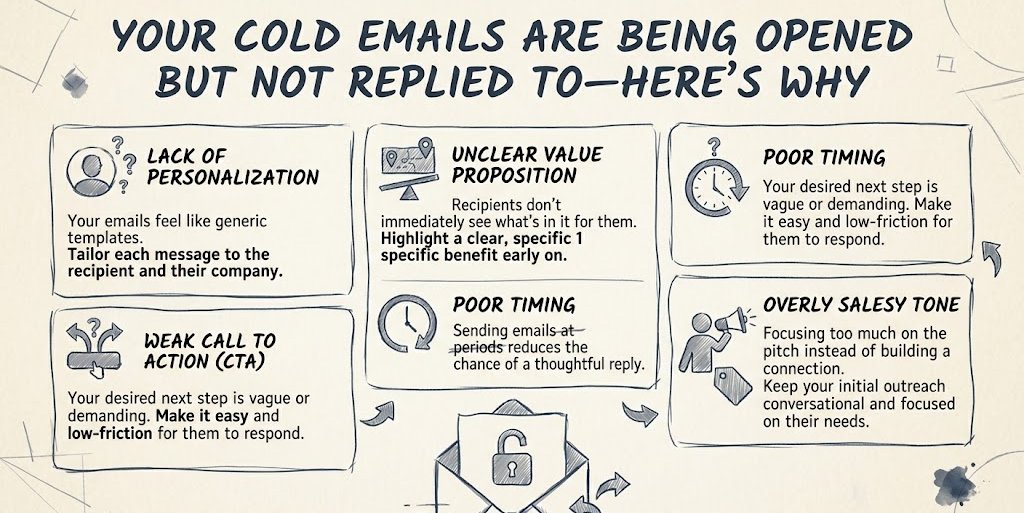
Fifty percent open rate. Sales team feeling good about it. Then a week goes by. Then two. Not a single reply. Not even a "not interested, thanks." Just quiet.
If you've run outbound for more than a few months, you've seen this. And it's confusing at first, because if people weren't into it, wouldn't they just... not open the email? Except opening costs nothing. A curious glance, a subject line that worked, gone in two seconds. Replying is a different animal entirely. It asks for a decision. Time. Actual thought.
So that's the real story behind the open-but-no-reply problem. Somewhere between "opened it" and "ignored it," something breaks. Usually it's one of a handful of things, and most of them have nothing to do with your subject line.
The subject line already did its job
Worth saying clearly: a subject line's only responsibility is getting the email opened. That's it. It's not supposed to build trust or explain your product or convince anyone of anything. Once it's opened, the subject line is done working. Everything after that point rests entirely on the body copy.
Which is exactly why open rate and reply rate barely correlate. One tells you the hook worked. The other tells you whether the whole email held together once someone actually started reading.
It's about them, not you
Read your last cold email out loud. Count how many sentences are about your company, your product, your results. Now count how many are about the person receiving it. If the ratio's off — and for most people it badly is — that's problem number one.
Prospects skim. Fast. And the question running through their head the entire time is some version of "why does this matter to me right now." An email that opens with "We help companies like yours..." doesn't answer that. It just restates that a sales pitch has arrived.
Contrast that with an opener that mentions something actually specific — a role change, something the company announced last month, a pattern common to their exact industry. It doesn't need to be clever. It just needs to prove the email wasn't copy-pasted five hundred times.
There's no question in the email
Go find your last ten cold emails. Seriously, pull them up. How many end with something a person can answer in five words or less?
My guess: not many. Most end with things like "Let me know if you'd like to learn more" or "Happy to jump on a call whenever works for you." Those aren't questions. They're off-ramps. They hand the entire decision back to the prospect — what does "more" mean, when is "whenever," is this worth figuring out — and busy people don't do that work. They just move on.
"Worth 15 minutes next Tuesday?" gets answered. "Interested in learning more?" gets ignored. That's basically the whole difference.
One email isn't a strategy
Here's something that gets missed constantly: a good email sent once is still easy to ignore. Not because it's bad. Because the prospect was mid-meeting, or dealing with a fire, or just not thinking about your category that day. An unanswered open usually isn't rejection. It's timing. And timing that doesn't get a second shot just... dies there.
That's the whole argument for sequencing. Not spamming — sequencing. A few emails spaced a handful of days apart, each one bringing something new instead of rehashing the last one. It keeps a door cracked open without turning into the person nobody wants to hear from again.
Asking for too much, too soon
Nobody wants a 30-minute call with a stranger the first time they hear from you. Yet that's the ask in a huge number of first-touch cold emails. It's like proposing on a first date — technically an option, rarely accepted.
Early in a sequence, smaller asks tend to land better. A quick opinion. A one-line answer. An offer to send something useful with zero obligation attached. Save the bigger ask — the demo, the call — for once there's a little familiarity in the tank.
It reads as if it came from a machine, not a person
This one's almost impossible to fake past a certain point. Prospects can tell, often within a sentence, when they're reading something mass-produced. Overly smooth phrasing. Zero personality. That template cadence where every sentence is the same shape and length.
The fix is almost annoyingly simple: write more like you talk. Shorter sentences here and there. A slightly casual line. Even a small imperfection can work in your favor — it reads as human, which, ironically, is exactly what makes someone want to respond to a human.
Of course, doing that across hundreds of prospects by hand isn't realistic for most teams — nobody's got the hours. This is usually where personalization efforts collapse: either everyone gets the same generic email, or a rep tries to research every prospect manually and burns half their day doing it. DoReach exists mostly to close that gap — pulling in the context (role changes, mutual connections, recent company news) automatically so reps aren't stuck choosing between generic-and-fast or personal-and-slow.
A quick gut-check before your next send
- Does the opening line reference the person, not your product?
- Is there one easy, specific question by the end?
- Is this one email part of a sequence, or a lone shot in the dark?
- Does the ask match how much trust actually exists at this point?
- If you read it out loud to a coworker, does it sound like a person wrote it?
The fix was never a better template
Open rate tells you the subject line worked. Reply rate tells you the email earned attention once someone was actually in it. Closing that gap isn't about clever tricks — it's relevance, one clear ask, decent timing, and writing that doesn't sound like it rolled off an assembly line.
Get those right, and the silence after the open starts turning into actual conversations.