Outreach Automation: How to Scale Personalized Prospecting Without Losing the Human Touch
Tools & AutomationBy Avis Sharma · Sep 25, 2026
A practical guide to automating outbound outreach — email sequencing, LinkedIn touchpoints, and personalization at scale — without turning your pipeline into spam.
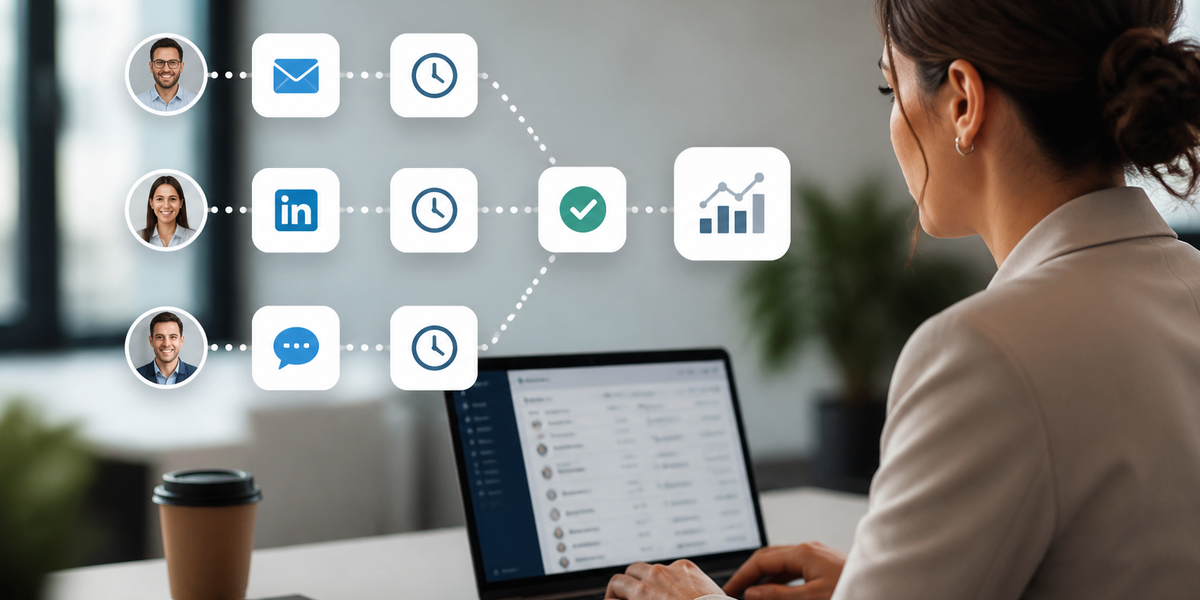
Why Outreach Automation Matters Now
Sales and growth teams are expected to generate more pipeline with the same headcount. Manually researching prospects, writing individual emails, and tracking follow-ups doesn't scale past a handful of conversations a day. Outreach automation closes that gap by handling the repetitive mechanics — sequencing, timing, and channel coordination — so reps can spend their time on conversations that are actually moving forward.
What Outreach Automation Actually Covers
Modern outreach automation isn't just "email blasts." It typically spans:
- Multi-channel sequencing — coordinating email, LinkedIn connection requests, InMail, and even calls into a single cadence.
- Dynamic personalization — pulling in prospect-specific data (role, company news, mutual connections) so messages don't read as templated.
- Behavioral triggers — automatically branching a sequence based on opens, replies, clicks, or website visits.
- List and segment management — keeping prospect lists clean, deduplicated, and properly enriched before outreach starts.
- Deliverability and warmup — protecting sender reputation so automated volume doesn't land in spam.
Building an Automated Outreach Workflow
1. Start With a Clean, Enriched List
Automation amplifies whatever you feed it. A poorly targeted list just means you send irrelevant messages faster. Before building sequences, verify emails, enrich contacts with firmographic and role data, and segment by buyer persona.
2. Design the Sequence Around Intent, Not Just Cadence
A good sequence isn't five generic touches spaced three days apart. Map each step to a reason the prospect would want to hear from you again: a new angle, a piece of social proof, a relevant resource. Mix channels — an email followed by a LinkedIn view or connection request often outperforms email-only cadences.
3. Personalize at the Template Level, Not Just the Name Field
Use merge fields for role, industry, and recent triggers (funding, hiring, product launches) rather than just first name. The goal is a message that could only have been written for that specific segment — even if it was generated at scale.
4. Automate Follow-Up Logic, Not Just Sending
The highest-leverage automation isn't the first send — it's what happens next. Auto-pause a sequence when a prospect replies. Auto-escalate to a call booking step when someone clicks a pricing link. Auto-remove bounced or unsubscribed contacts everywhere at once.
5. Protect Deliverability From Day One
Warm up new sending domains and mailboxes gradually, monitor spam complaints and bounce rates, and rotate sending accounts for higher volume. Automation that ignores deliverability just automates getting flagged as spam faster.
6. Measure and Iterate
Track reply rate, positive reply rate, and meetings booked per sequence step — not just open rate. Use that data to prune underperforming steps and double down on what's converting.
Common Pitfalls to Avoid
- Over-automating to the point messages feel robotic or clearly mass-produced.
- Skipping list hygiene and burning sender reputation on bad data.
- Running every prospect through the same sequence regardless of segment or intent signal.
- Never pausing automation for prospects who've already replied or converted.
The Bottom Line
Outreach automation works best as a force multiplier for a well-designed process, not a replacement for strategy. Get your targeting, messaging, and deliverability right first — then let automation handle the volume and consistency a human team can't sustain manually.